The whole algorithm in the open

Loosen does two things with your data. It scores your flexibility, and it chooses your next stretch session. This page shows exactly how both work, every signal and every weight.

Last reviewed May 2026
01Why

Your plan should change when your day does

Most stretching apps give everyone the same plan. Loosen reads what your body did each day and responds to it. The score and the routine both run on a fixed set of rules, not AI. The rest of this page is those rules.
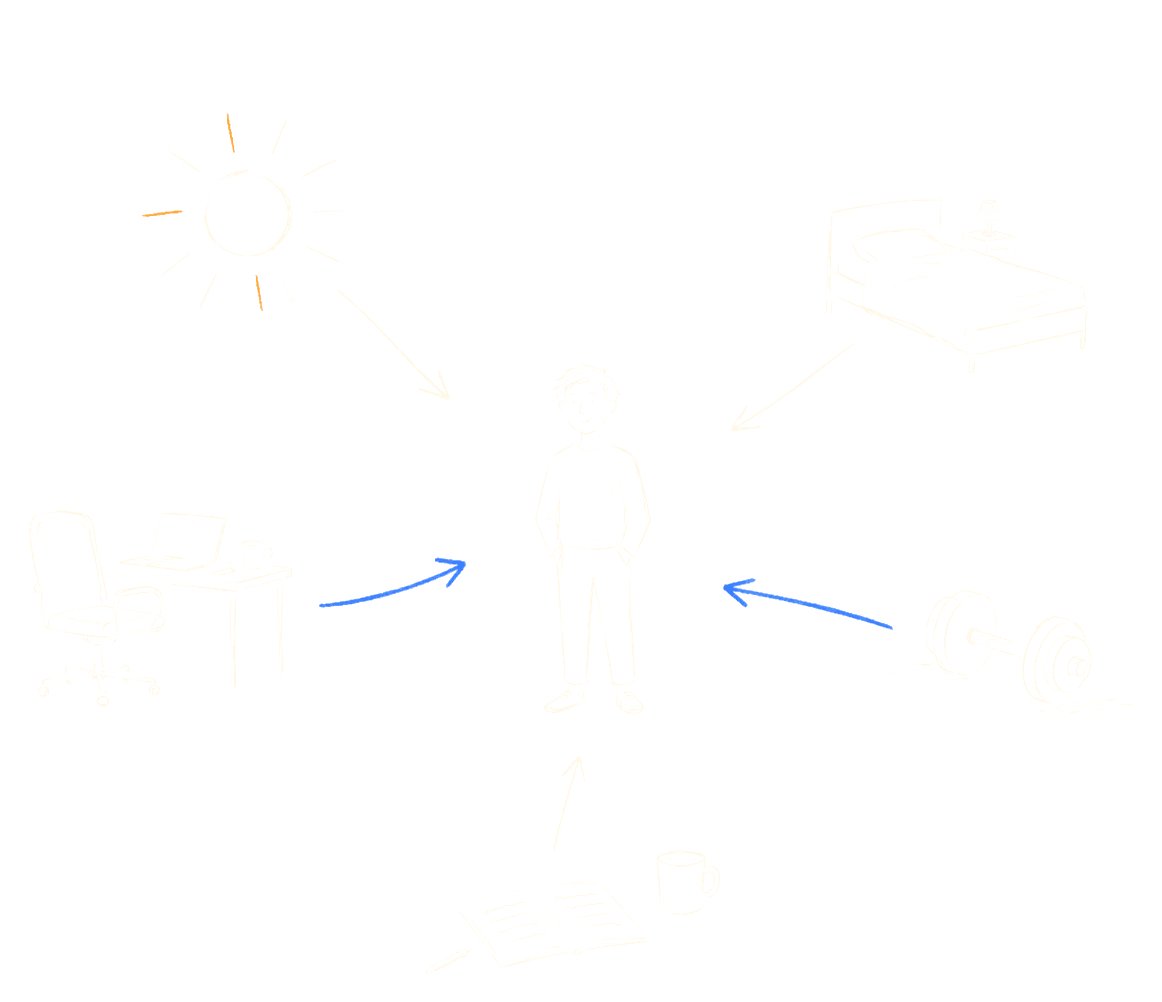
A hand-drawn sketch of a person surrounded by the things that shape their day: sunlight, sleep, desk work, training, and journaling.
02The score

The score is baseline minus penalties

The score is deterministic. The same inputs always give the same number from 0 to 100. It has two parts: a baseline from your onboarding assessment, and daily penalties subtracted from it.
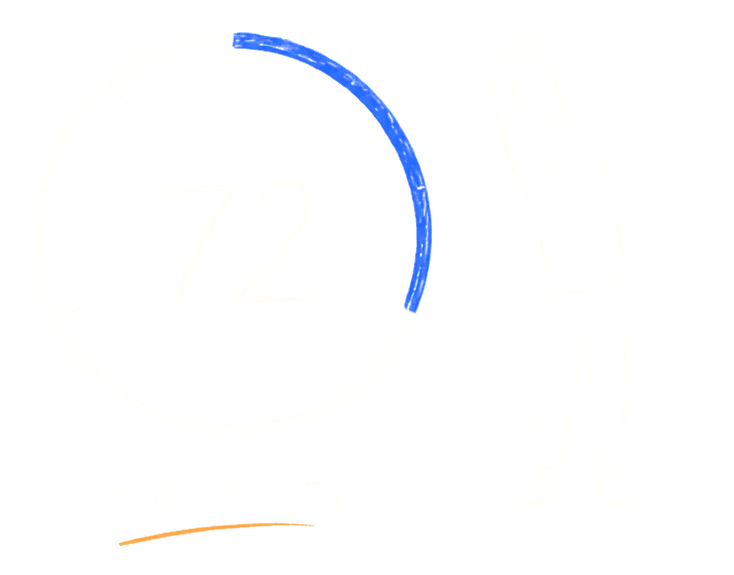
A hand-drawn flexibility score ring reading 72, beside a person mid-stretch.
Baseline
50–100
Four areas, each given a weight.
Hips×1.5
Spine×1.3
Shoulders×1.2
Hamstrings×1.0
A 50 to 100 starting point. Set once at onboarding.
Penalties
Points subtracted for recent signals:
−8 hard workout day
−6 short sleep
−4 sleep debt
Examples only. The full list is in the next section.
=
Score
68
Rounded to a whole number. Capped at 0 and 100.
One note

In the app, the score appears as a list of pluses and minuses. The calculation is only baseline minus penalties. The pluses show what you avoided, not a separate step.

03Score inputs

Nothing moves the score without a number

Each bar is scaled against the largest penalty a single signal can apply. Some inputs are always on. Others switch on once the app has a few days of your data.

Neglected areas
The days since you last stretched each area, counted past a one-week grace period.
Impact−0.5 / day, no cap
A long sit
More than 8 idle hours yesterday. The largest single penalty. iPhone only, since Android does not report this.
Impactup to −12
A hard workout day
A strength session in the last 24 hours, when muscles are still loaded.
Impact−8
Short sleep
Under 7 hours last night. The deeper the shortfall, the larger the penalty.
Impactup to −6
Stale movement
More than 36 hours since your last logged workout.
Impactup to −2
Broken sleep
Four or more wake-ups last night.
Impact−1.5
Low HRV
Heart-rate variability below your normal range.
Impactup to −4.5
Sleep debt
A sleep shortfall across the last three nights.
Impactup to −4
Low movement
A step count below your normal range.
Impactup to −2
04Demand model

The routine goes where your body needs it

Before a routine is chosen, the app works out which body areas need attention. Every one of the eight areas carries a running score for how much work it needs. On top of that base, these signals push specific areas up.
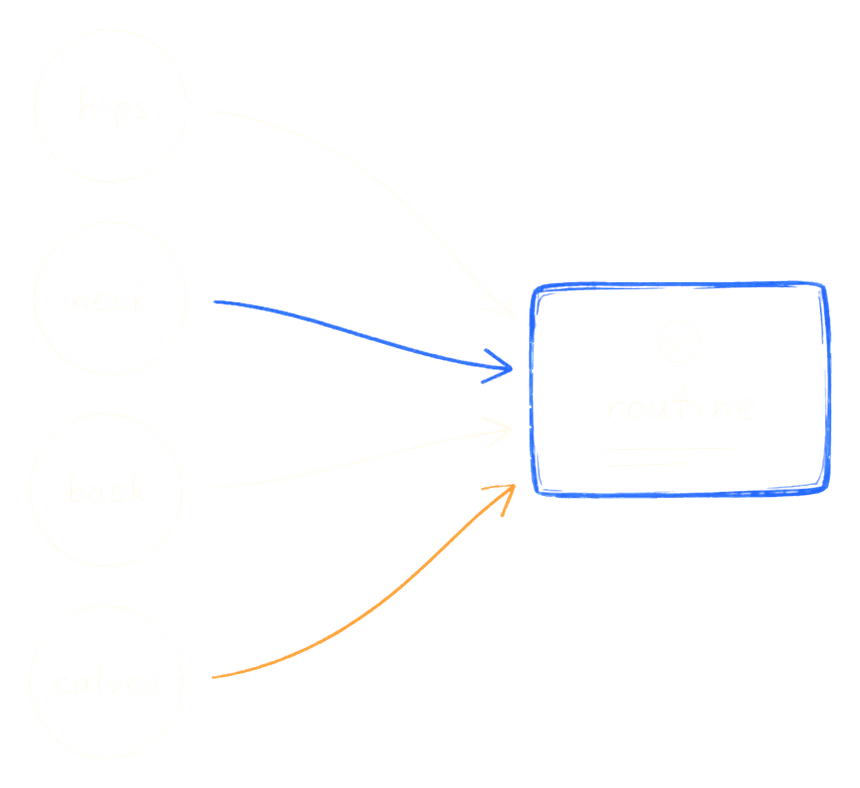
A hand-drawn diagram of body areas (hips, neck, back, calves) feeding into a chosen routine.
HipsLower backHamstringsNeckShouldersMid-backAnklesCalves
Tight areas1.0 down to 0.2
The areas you marked tight. The last five sessions count, the most recent the most.
Sharp areas1.5 down to 0.7
Areas you marked sharp. Counted higher than tight, and held longer.
Problem areas0.5
The tight areas you flagged at signup.
Sharp areas1.0
Drops to 0.4 once five sessions of feedback never mention the area.
A rising sitting trend1.0
This week's sitting more than an hour above your two-week average.
Chronic sitting1.2
More than 8 idle hours a day on average. Loads hips, mid-back, and neck.
Recent workouts1.0 then 0.7
The muscles a workout loads, at full weight for 4 hours, then again through the soreness window.
Untouched areas0.3 / day
Areas you have not stretched in over 5 days, building up to a two-week cap.
05Routine pick

The highest-scoring routine wins, every time

Demand decides which areas need work. Then every candidate routine is scored against these rules, and the highest score is your pick.

These are point adjustments to a routine’s score, not a to-scale bar. They stack differently for every candidate routine.

Area targeting
How well a routine covers the areas demand has raised. This is the core of the score.
core score
Done recently
A routine you ran in the last 24 hours drops 3 points, in the last 3 days 1.5. Keeps the rotation fresh.
−3 / −1.5
A change of focus
A small bonus for targeting a different area than your last session.
+0.5
After sharp pain
Flag a sharp area and the next two sessions are capped to gentler routines. Harder ones are pushed well down.
−10 capped
New to stretching
If you set up as a beginner, routines above beginner level are penalised.
−5
A tired day
Short sleep or a quiet few days nudges the pick toward gentle, restorative routines.
+1
Just after a workout
In the four hours after a workout, cool-down routines are boosted.
+2
Unsafe poses
Routines with poses that are contraindicated for your health conditions are removed before scoring.
removed
Where it runs

This pick is a plain scoring pass on your phone. It runs in milliseconds, needs no internet, and uses no AI. The same inputs always produce the same routine.

The loop
01
The score picks a routine
02
You run the session
03
You tap what is still tight

What you tap feeds straight back into demand for the next pick.

06Health data

It works without health data, and sees more with it

Still a real score and a real pick
The score runs on your baseline and how recently you stretched each area.
The routine pick runs on your feedback, onboarding answers, and neglect.
Sleep, sitting, and workout signals simply stay off.
07Privacy

The score never leaves your phone

The score and the routine pick are both computed on your device. Nothing about either needs the internet. AI is a separate, optional layer, and it is off until you turn it on.

Nothing is sent out
Routines come from a library built into the app: 191 routines drawn from 219 illustrated poses.
Written explanations use pre-written copy.
Nothing is sent to Anthropic.
What is never sent

Raw health records, meaning the heart-rate readings, HRV series, and sleep-stage data, are never sent. Only the derived averages are, and only while AI consent is on. Anthropic does not keep the data or use it for training.

08Limits

Three things it cannot do yet

Each is a real limit, named here on purpose.

Resting heart rate, breathing rate, blood oxygen
Read from your phone, but not yet used in the score.
The assessment baseline
Set once during onboarding. There is no retake yet, so the baseline part of the score does not change.
The reason shown in the app
The routine card shows a short, one-line reason. The full scoring on this page is not shown inside the app.

A score is only as trustworthy as the rules behind it.

That is the reason for this page, limitations and all. It is updated whenever the algorithm changes.

Download Loosen